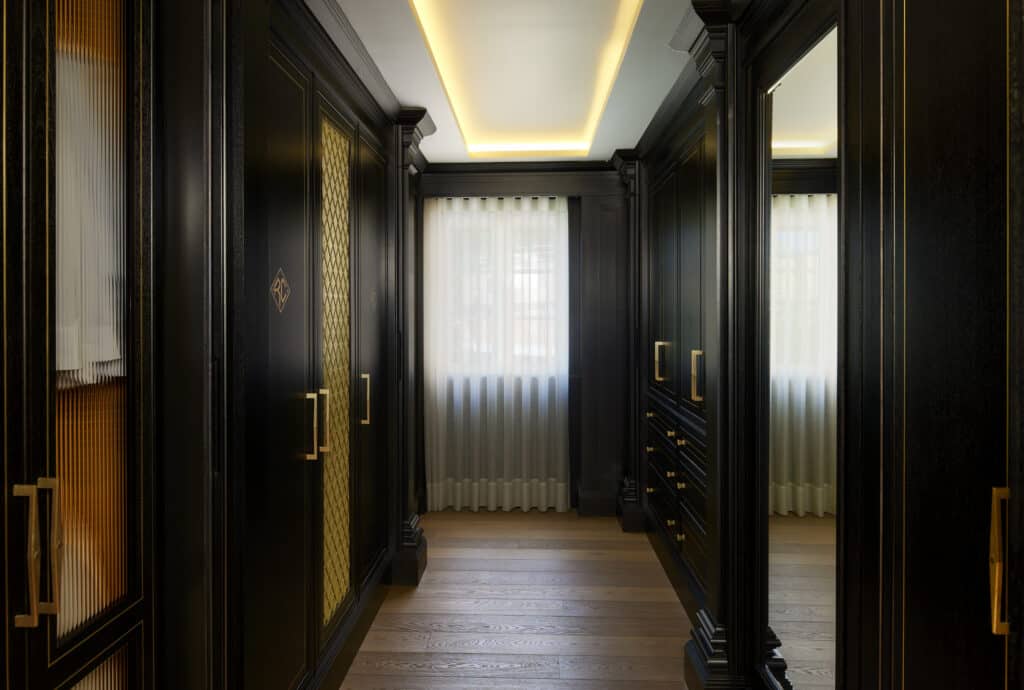
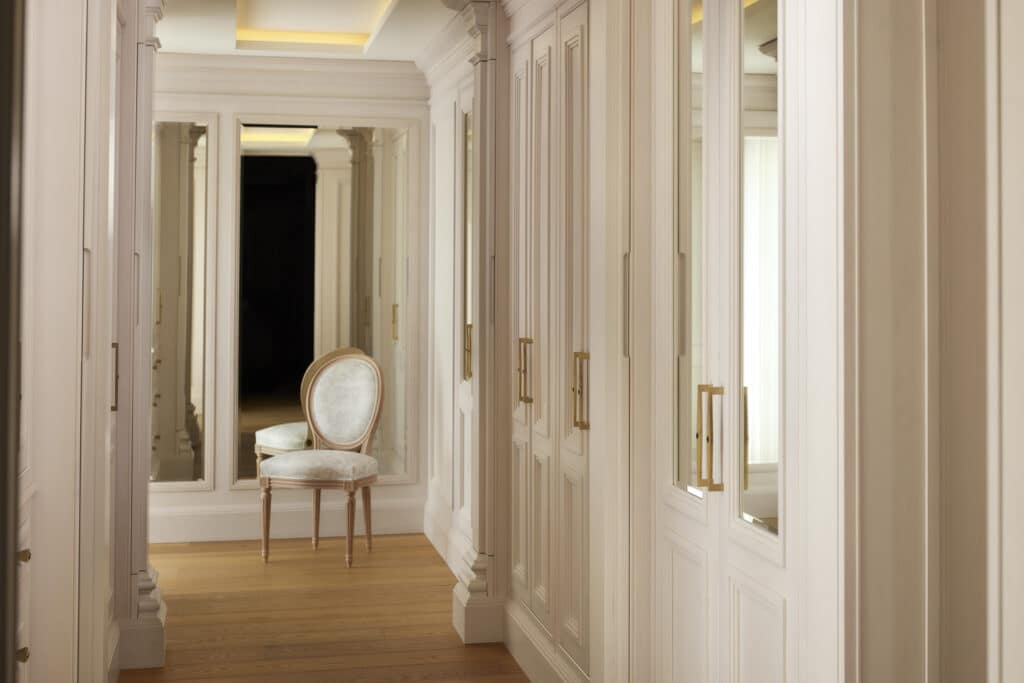
Discover how a luxury dressing room can become one of the most elegant and personal spaces in the home.
The dressing room is, in many ways, the most personal room in the home. It is where the day begins and ends; where the rituals of dressing and undressing unfold in private. And yet, for all its intimacy, it is a space that is too often treated as an afterthought; a room defined by what it stores rather than by how it feels to be within it.
At Clive Christian Interiors, we believe that luxury dressing room design deserves the same architectural rigour, material integrity, and depth of thought as any other room in the home. A truly considered dressing room is not simply well-organised. It is beautifully resolved: a space that responds honestly to the character of the home, the lifestyle of the client, and the daily rhythms of the person who inhabits it.
Whether you are gathering dressing room ideas for the first time or refining a vision, this guide sets out the principles that distinguish a bespoke dressing room from the simply functional and explores the walk-in wardrobe ideas and design approaches that make that difference.
what makes a luxury dressing room?
A luxury dressing room is not defined by its size. Some of the most remarkable dressing rooms we have created have occupied modest footprints; others have filled entire floors of townhouses. What defines a truly luxurious space is the quality of thought behind every decision, from the way the cabinetry responds to the proportions of the room, to the precision of a joint, to the way light is considered at different times of day.
Luxury dressing room design is, at its finest, as architecturally rigorous as the design of a kitchen or a dining room. The cabinetry is not placed within the space; it is designed for it, responding to ceiling heights, existing features, natural light and the materials of the wider home.
“A bespoke dressing room commission begins long before a single piece of cabinetry is designed. It begins with understanding how a person lives, how they dress, what they collect, how they move through the space at different times of day. When that understanding is at the foundation of every decision, the result is something that feels entirely inevitable: a room that could only ever have belonged to you. At Clive Christian, that level of personal response is not an ambition, it is simply how we work.”
Oliver deadman, head of design, Clive christian interiors
dressing room ides: where to begin
The earliest conversations about a dressing room project are often the most important. They establish not simply what the space will contain, but what it will feel like to inhabit, and how it will sit within the character of the wider home.
understanding your architecture
The architecture of the room is the foundation upon which all other decisions rest. The ceiling height, the quality of natural light, the presence of original features, the materials of the floors and walls, all of these inform the design language of the cabinetry. A dressing room in a Georgian townhouse calls for something fundamentally different from one within a contemporary apartment, not because one is superior to the other, but because each deserves a design that is honest to its setting.
At Clive Christian, we design dressing rooms that belong to their homes. The cabinetry responds to the building; it does not simply occupy it.
planning your wardrobe inventory
Our designers will guide you through a considered review of your wardrobe, including the garments, shoes, accessories and collections that the room needs to accommodate. This is not simply a practical exercise; it is the foundation of a design that truly serves your life. Formal wear requires different hanging heights and depths from everyday clothing. A significant shoe collection calls for a different approach from one where suitcases and sportswear take precedence. Where a space is shared, both wardrobes are considered in full, with the room proportioned and planned to serve each with equal care.
walk-in wardrobe ideas: layout & configuration
Walk-in wardrobe design begins with the spatial opportunities the room presents. A long uninterrupted wall, the flanking sides of a chimney breast, the vertical potential of a room with generous ceiling heights; each offers a different set of possibilities, and a different kind of beauty. Our designers work with the geometry of the space, not against it, identifying where cabinetry can run floor to ceiling and where a lower run creates balance and proportion.
Walk-in wardrobe ideas range in configuration from a single-wall arrangement, considered and restrained, to a U-shaped or L-shaped layout that wraps the room in storage of quiet abundance. Where ceiling height allows, a double run of cabinetry, with upper cupboards dedicated to seasonal or occasional pieces, maximises the room without sacrificing elegance. In every case, the guiding principle is that the finished space should feel unhurried: generous without excess, ordered without rigidity.
the dressing island
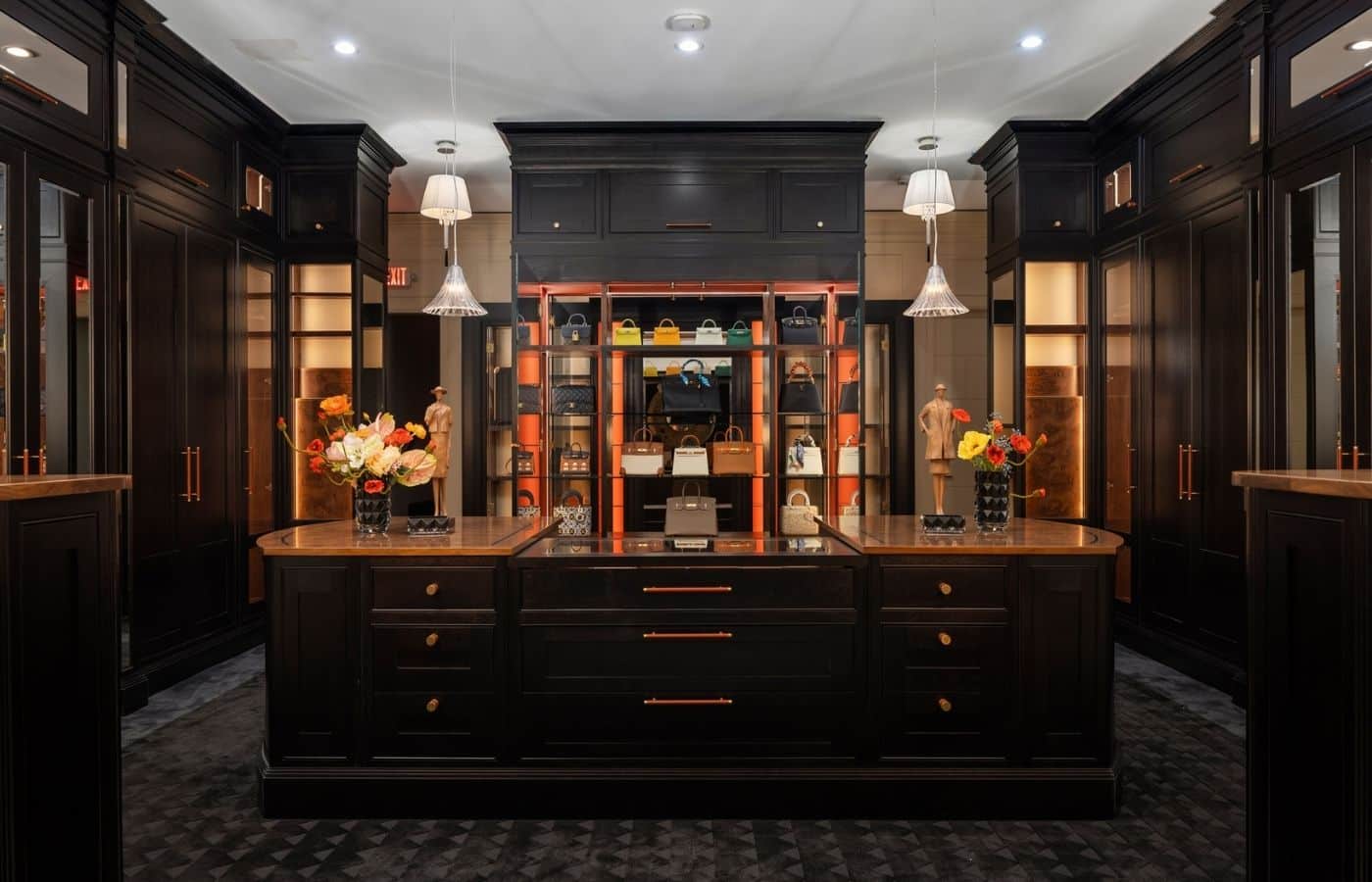
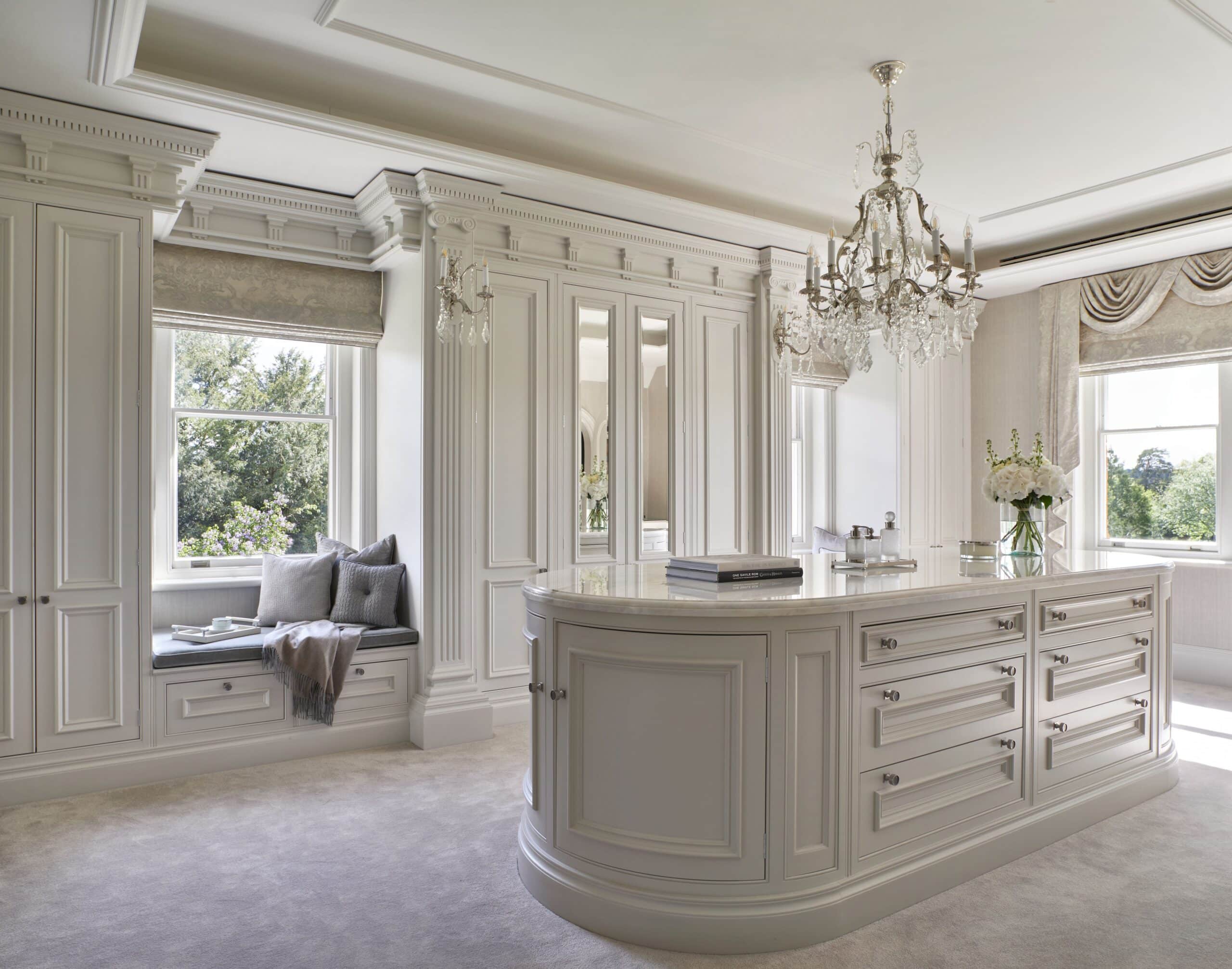
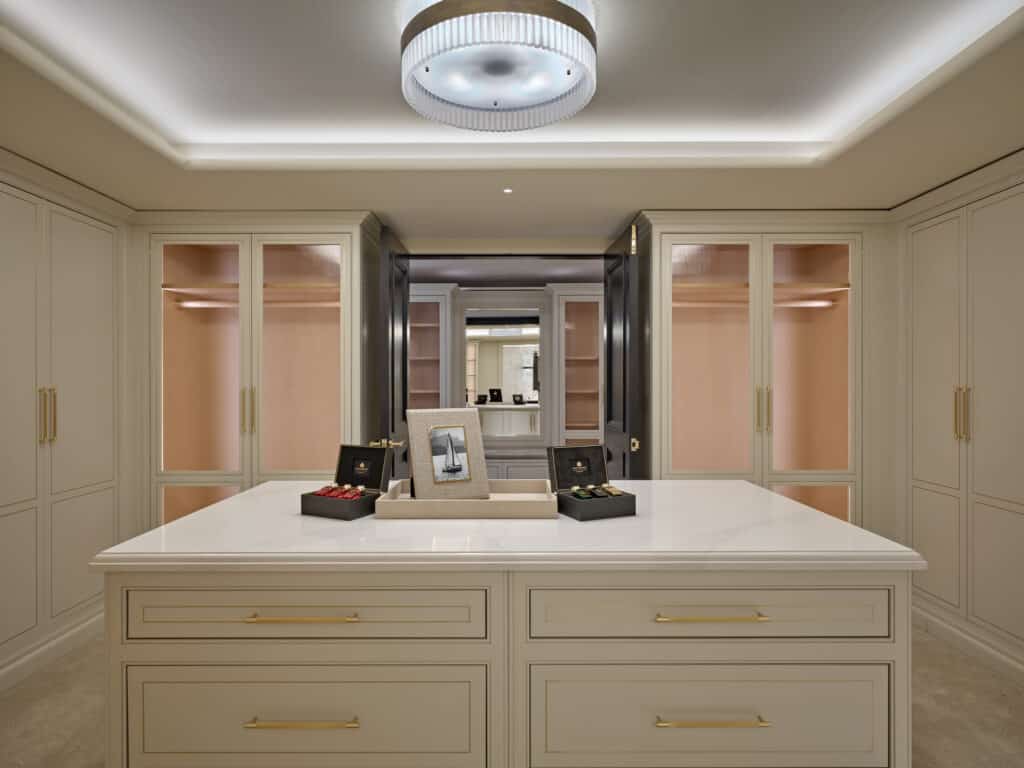
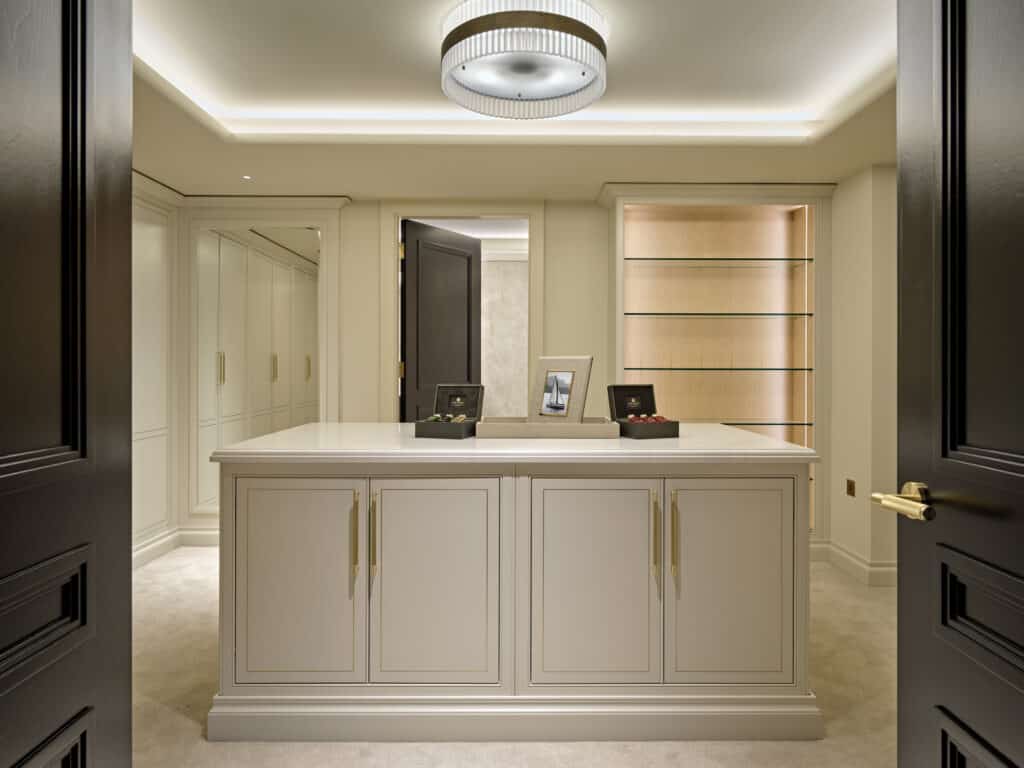
Where the footprint of the room allows, a central dressing island is among the most transformative elements a walk-in wardrobe can include. It changes the nature of the space entirely, from a room you enter to retrieve something, to one you inhabit with ease and pleasure. Drawers below provide discreet storage for folded garments, velvet-lined trays and compartments for jewellery and accessories. The surface above becomes a considered place to lay out an outfit, to organise before travel, or simply to pause.
In a his-and-hers configuration, the island often becomes the shared centrepiece of two distinct spaces, a room within a room, where two entirely personalised wardrobes find their natural meeting point.
the luxury walk-in closet: storage, fittings & interior detail
The interior of a luxury walk-in closet is where the true quality of a bespoke commission becomes most apparent. At Clive Christian, we bring the same level of craft and intention to the inside of a drawer as to the face of a door. Nothing is considered secondary.
Hanging rails are specified for the precise requirements of what they will hold, including long-hang options for evening wear and formal garments, double-hang for shirts and jackets, and adjustable configurations for wardrobes that need to evolve. Shelving is designed for shoes, folded knitwear, and accessories with the same attention to proportion. Drawers are lined with velvet in tones chosen to complement the cabinetry, with internal compartments for jewellery, cufflinks and accessories that deserve to be both protected and beautifully presented.
specialist storage & considered details
The details that distinguish an exceptional walk-in closet design are often those that go unnoticed until they are absent. Pull-out shoe displays that present a collection rather than simply storing it. Belt and tie racks positioned at exactly the right height. Mirrored interiors that amplify light and allow a garment to be seen from every angle. Cedar of Lebanon lining, which imparts a naturally fragrant quality to the space and acts as a gentle, entirely natural deterrent against moths, particularly valued for the storage of fine cashmere and delicate wools.
For clients with significant watch, jewellery or accessory collections, bespoke integrated safes can be incorporated seamlessly into the cabinetry. These may be operated by fingerprint recognition, concealed behind a full-length mirror, or housed within a dedicated display cabinet with low-iron glass to protect and present what is most precious.
Materials, Finishes & Craftsmanship
The materials of a bespoke wardrobe design are as central to its character as its layout or configuration. At Clive Christian, we work with premium hardwoods, fine lacquers, timber veneers, exotic leathers, decorative glass and handcrafted inlay, selected not only for their beauty but for their ability to endure. A luxury wardrobe design should not simply look exceptional at the point of completion; it should deepen and improve with time, as the finest things often do.
Hand-painted cabinetry, drawn from a curated palette of exclusive colours, allows the dressing room to sit in quiet conversation with the rooms that surround it, or to assert a distinct character of its own. Timber veneers, in American ash, European oak, black walnut or frosted maple, bring warmth and grain to contemporary schemes. For those who wish the dressing room to make a more personal statement, bespoke marquetry, decorative inlay and client monograms offer individuality. It is this depth of personalisation that defines luxury wardrobe design at its most complete.
Every piece is handcrafted in our Lancashire workshop, where traditional cabinet-making techniques, refined over nearly fifty years, are brought to bear on each commission with precision and care.
Lighting a Luxury Dressing Room
Lighting in a dressing room serves a purpose that is both practical and atmospheric, and it deserves to be considered from the earliest stages of the design.
Integrated LED lighting within hanging cupboards and drawers ensures that every corner of the wardrobe is visible and accessible, whatever the hour. At a dressing table or vanity, the colour temperature of task lighting matters considerably. Too warm and it flatters without informing, too cool and it is simply unpleasant. Our designers will guide you on placement and specification to ensure that the lighting serves you well in every sense.
Plinth lighting along the base of cabinetry adds a layer of atmospheric warmth at floor level, while carefully positioned ambient sources establish the mood of the room as a whole. The result is a space that feels considered in every light, literally and otherwise.
Beyond the Wardrobe: The Modern Luxury Dressing Room
The most compelling designer dressing rooms of today are no longer defined solely by storage. They are private retreats, spaces conceived for comfort and pleasure as much as practicality, in which the experience of getting dressed becomes something genuinely to look forward to.
This evolution mirrors what we witnessed in the kitchen a generation ago: a room once defined entirely by function, gradually understood to be one of the great living spaces of the home. Today’s bespoke dressing room is, increasingly, designed to be spent in; a room where a dry bar for the evening and a coffee station for the morning sit as naturally alongside the cabinetry as a comfortable chair and a well-considered lighting scheme.
Warming drawers that gently preheat linens and robes for the morning. Sub-zero drinks stations integrated seamlessly behind cabinetry doors. Entertainment systems recessed into the design with no visible intrusion. Each of these features, specified with the same care as every other element of the room, transforms a dressing room into a space that enriches daily life rather than simply organising it.
Bespoke Dressing Room Collections from Clive Christian
Each of our collections brings a distinct design sensibility to the dressing room, and each can be tailored with absolute precision to the architecture of a home and the preferences of its client.
For homes of traditional character, including Georgian townhouses, Edwardian country properties, and period residences of distinction, our Architectural and Edwardian collections offer a classic dressing room aesthetic rooted in the great interiors of British craftsmanship. In-frame cabinetry, hand-painted finishes, warm timber interiors and decorative mouldings create a space that honours the heritage of the building and deepens in richness over time.
For those drawn equally to tradition and contemporary clarity, Metro Deco and Alpha Deco occupy a considered space between the two. Metro Deco, with its flat wooden doors and hand-pressed decorative inlay, bridges classical craftsmanship and contemporary design in a way that feels wholly original. Alpha Deco, inspired by the geometric discipline of the Art Deco movement, brings structured symmetry and architectural presence to a bespoke wardrobe of either traditional or contemporary setting.
For a fully contemporary dressing room, our Opus collection offers a modular design philosophy of exceptional precision, available in American ash and European oak, with surface finishes of extraordinary character. Where the bespoke wardrobe is to make a statement of quiet, enduring originality, Opus delivers it.
discover Your Bespoke Dressing Room
If you are beginning to consider a luxury dressing room or walk-in wardrobe project, we would be delighted to guide you through the possibilities. Our design team works closely with each client from the earliest conversation through to the final installation, ensuring that every decision is made with care, intention and a complete understanding of how you live.
Visit one of our showrooms or contact our design team to begin the conversation. The result will be a dressing room that does not simply reflect your style, but feels as though it could never have belonged to anyone else.
Frequently Asked Questions About bespoke cabinetry and luxury kitchen design
What is a luxury dressing room? A luxury dressing room is a bespoke interior designed to support and elevate the daily rituals of dressing and undressing, in a space that is as beautiful as it is functional. It is defined not by its size but by the quality of thought, materials and craftsmanship that have shaped every element within it, from the precision of the cabinetry to the warmth of the lighting and the intelligence of the storage. At its finest, a luxury dressing room is a private retreat: a space that feels entirely personal, deeply considered, and a genuine pleasure to inhabit.
How do I plan a bespoke dressing room design? The most effective starting point for any bespoke dressing room design is a conversation about how you live. Before dimensions, layouts or finishes are considered, our designers will take time to understand your routines, your wardrobe, your collections and your vision for the space. From there, the design emerges in response to the architecture of the room and the specifics of your lifestyle; a dressing room plan that is entirely your own, from its broad configuration down to its smallest interior detail.
What is the difference between a dressing room and a walk-in wardrobe? The distinction between a dressing room and a walk-in wardrobe is primarily one of scale and intention. A walk-in wardrobe design typically describes a dedicated storage space with sufficient room to move freely within it, arranged around the perimeter of the room. A dressing room implies something more fully realised: a space that has been designed to be inhabited, often incorporating a dressing island, seating, a dressing table and, increasingly, comfort features that extend its use well beyond the act of dressing. In practice, the two terms are often used interchangeably, and at Clive Christian, every commission, whatever its size, is designed with the depth of thought that the finest dressing rooms deserve.
What should a luxury walk-in closet include? A luxury walk-in closet should include everything the person who inhabits it needs, and nothing they do not. At minimum, this means a thoughtfully configured combination of hanging space, shelving, drawers and specialist storage for shoes, accessories and valuables, all designed with precision and finished to the highest standard. Beyond that, the most considered walk-in closet designs incorporate a central island, integrated lighting, velvet-lined drawers, mirror placement for dressing, and where space and lifestyle allow, comfort features such as seating and integrated appliances. The defining quality of a luxury walk-in closet is that every element has been designed for the specific person who will use it, not as a standard specification, but as a genuinely personalised wardrobe.
How do I choose the right wardrobe design for my home? The right wardrobe design for your home begins with its architecture. A period property with original features and traditional proportions will typically benefit from a design that honours and responds to those qualities, for example, in-frame cabinetry, hand-painted finishes, and decorative detailing that sits naturally within the fabric of the building. A contemporary home may call for a more restrained approach, where the precision of the surfaces and the quality of the materials do the work that mouldings and cornicing do in a traditional scheme. For many clients, the most satisfying outcome lies between the two. Our designers will guide you through these possibilities from the very first conversation.
Can a bespoke wardrobe be designed for a shared dressing room? Yes, and a shared dressing room, designed with genuine care for both occupants, can be among the most extraordinary spaces we create. His-and-hers configurations allow each person’s wardrobe to be planned entirely around their own collection and requirements, with distinct material choices, colour palettes and interior fittings that reflect individual personalities within a unified design. A central dressing island, a shared lighting scheme and a custom closet design that has been proportioned to serve both wardrobes equally bring the two spaces together. The result is a room that belongs to both, and wholly to each.
Whether you’re gathering ideas or ready to begin your project, our concierge team is on hand to help with friendly, no-obligation advice. Call to reach an expert or schedule a consultation below.