
The Luxury Kitchen Island as the Heart of the Home
Every kitchen has a room’s worth of decisions to make: layout, storage, materials, light. Few of those decisions carry as much weight as the island. Get its proportion, position, and purpose right, and the rest of the room tends to fall into place around it.
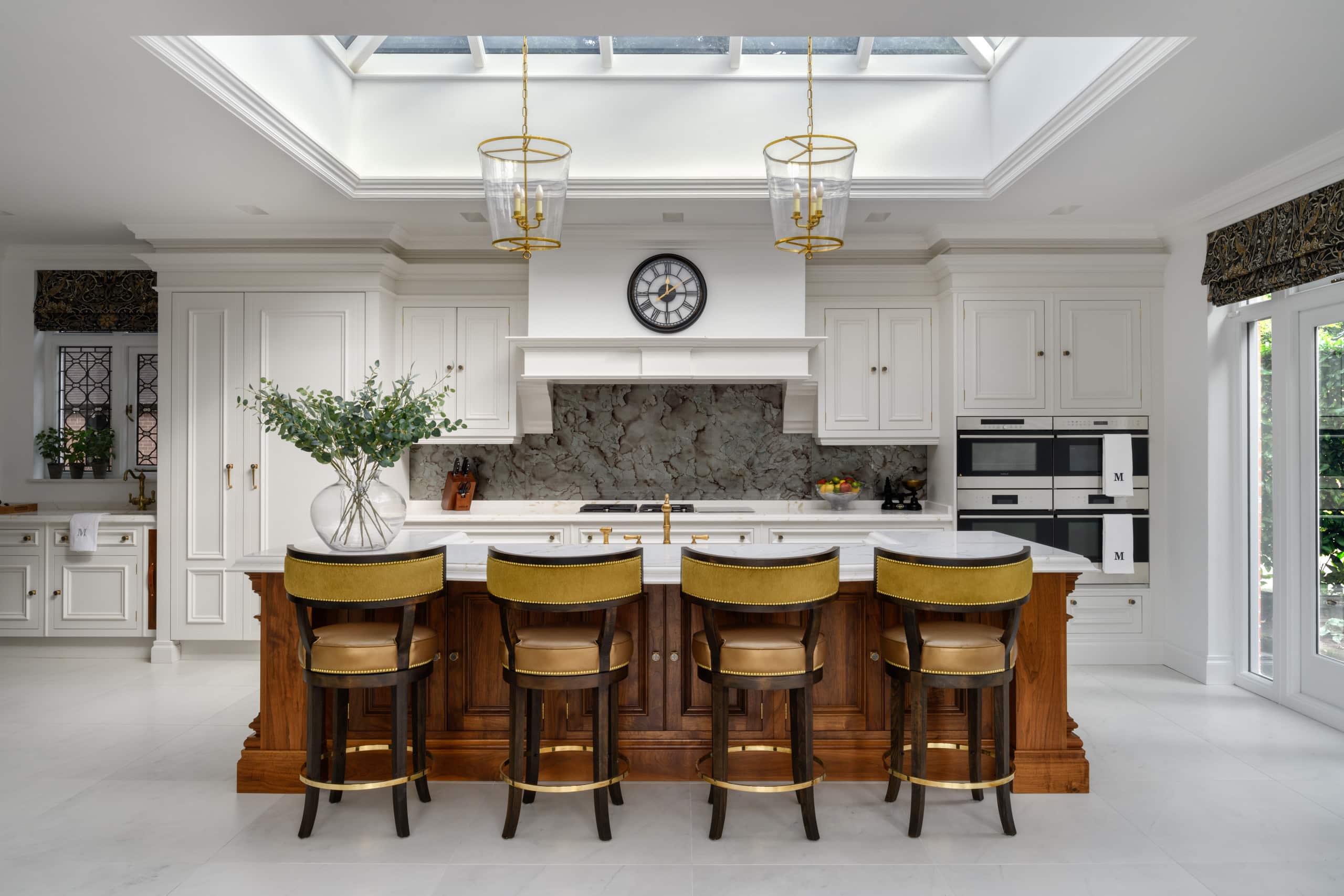
Every kitchen has a room’s worth of decisions to make: layout, storage, materials, light. Few of those decisions carry as much weight as the island. Get its proportion, position, and purpose right, and the rest of the room tends to fall into place around it. That is, in the truest sense, what makes a luxury kitchen island the heart of the home. Not because the phrase sounds well on a mood board, but because it is so often where a home genuinely gathers, and where a bespoke design earns or loses its sense of proportion. The kitchen island is one of the ideas we return to often, including in our broader look at luxury kitchen design for 2026, but it deserves a closer look on its own.
What a Bespoke Kitchen Island Shapes
Because so much of a kitchen’s character radiates outward from its island, the decisions made there rarely stay contained to the island itself. Its footprint determines how much space remains for run cabinetry along the walls. Its height and depth decide whether it can comfortably hold a hob, a sink, or simply stand free as a place to prepare, serve, and sit. Its proportion, relative to the room around it, decides whether a kitchen feels generous or crowded.
This is where a large kitchen island earns its scale, rather than simply filling it. In a well-proportioned room, a substantial island can absorb prep space, storage, and seating without ever feeling like the room has been built around a single oversized object. In a smaller kitchen, the same thinking works in reverse: a modern kitchen island might be kept slender and freestanding in feel, doing less on its own but doing it precisely.
Clearance matters as much as size. However generous an island’s proportions, the space around it needs to allow for two people to pass comfortably, cupboards to open fully, and the everyday movement between hob, sink, and fridge to happen without obstruction. A kitchen island design that looks striking on paper but crowds the room around it has usually been sized to the space available, rather than to how the space will actually be used.
None of this is decided by rule of thumb. Each kitchen island design is worked out through a conversation about how the room is actually used, day to day, long before it becomes about materials or finish.
Built to Last, Not to Trend
It is a fair question, and one we are asked often: does a kitchen island go out of style? Trend-led ones can, because they were designed to answer a single moment rather than a single family. A custom kitchen island starts from a different brief altogether: not what looks right this year, but what suits the proportions of this kitchen, the materials of this home, and the way this particular household actually lives.
That specificity shows up in decisions most people never notice once a kitchen is finished: American ash or European oak selected for grain and stability as much as appearance, joinery cut and fitted by hand rather than assembled from a template, a hand-pressed inlay or a hand-finished surface given the hours it needs rather than the hours a production line allows. None of it announces itself on its own. Together, it is why a Clive Christian island still feels considered a decade after it was built, long after a trend-led equivalent would have needed replacing.
It is, in that sense, the most enduring piece a bespoke kitchen island can be, built for the family who commissioned it rather than for the season it happened to be finished in.
Seating, Gathering, Proportion
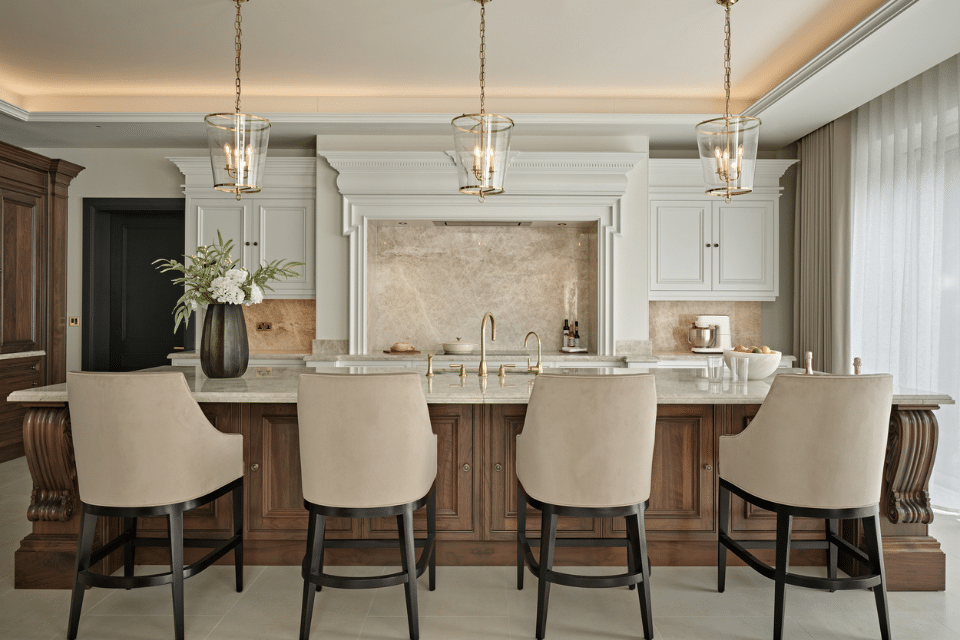
Ask most people what draws them to a bespoke kitchen island with seating, and the answer rarely mentions storage or worktop space first. It is almost always about people. An island with seating provides somewhere for a guest to sit with a glass of wine while dinner is prepared, somewhere for a child to do their homework within easy reach of a parent, somewhere for a conversation to happen without anyone having to leave the room.
Getting this right is a matter of proportion as much as preference. Seating needs to sit comfortably alongside a working island without crowding the cook or interrupting the flow between hob, sink, and fridge. Overhang, height, and the depth of the surface all play a part in whether an island with seating feels genuinely inviting or simply added on. Among the kitchen island ideas we return to most often with clients is treating seating as part of the island’s original architecture, considered from the very first sketch, rather than a feature bolted on once the layout is otherwise fixed.
Done well, seating turns an island from a place of preparation into a place of gathering, which is, in the end, the whole point of building one at all.
One Luxury Kitchen Island, Five Expressions
Because every Clive Christian kitchen is bespoke, no two islands look quite the same, even within the same collection, but each of our collections brings its own distinct language to how an island is built and finished.
Architectural brings precision above all else. Within this collection, an island is conceived as an integrated, disciplined piece, its lines drawn to sit with quiet authority at the centre of a classically proportioned kitchen.
OPUS, our first contemporary collection, reimagines the island as a single, framed piece of furniture rather than a run of separate units. Finished in Effervesce, with its carved dimple detailing and warm gold shimmer, or Ethereal, with its organic, silvered ripple inspired by ash bark, an OPUS island becomes the room’s obvious focal point without ever losing the material heritage that runs through the wider portfolio.
Edwardian carries the weight of tradition into the island itself, with the same detailed joinery and heritage-led proportion found throughout the collection, built to anchor a kitchen that draws its character from the architecture of the home around it.
Metro Deco turns the island into something genuinely personal. Its hand-pressed inlay and bespoke marquetry allow a family crest, initial, or monogram to be worked directly into the cabinetry, placing something entirely unique to the household at the literal centre of the room.
Alpha Deco, with its square-framed door and recessed flat panel, gives a modern luxury kitchen island a crisp, geometric presence drawn from the Art Deco movement. That clarity of line is what makes it so versatile, equally at home anchoring a period kitchen or a contemporary one, ideal where a room needs to bridge the two.
“The island is rarely just one more piece of cabinetry,” says Oliver Deadman, Head of Design at Clive Christian Interiors. “Get its proportion and purpose right, and it sets the tone for how a family actually lives in the room. That’s why we give it the same care and attention as any other piece of furniture in the home, rather than treating it as a fixture to be fitted in.”
If you’re beginning to think about how a luxury kitchen island could work for your home, we would be glad to speak with you. Book a design appointment, visit one of our showrooms, or explore how a bespoke kitchen island takes shape across our collections.
Frequently Asked Questions
Does a kitchen island need to match the rest of the kitchen?
Not necessarily. Because we treat each island as its own considered piece rather than a length of matching cabinetry, many of our clients choose a different finish within the same collection; an OPUS island in Effervesce set against cabinetry in Ethereal, for instance, or a different timber altogether. The two are always designed together, but they don’t need to be identical to belong in the same room.
Can a kitchen island include a hob or sink?
Yes, and both are considered from the earliest design stage rather than added afterwards. A sink keeps the cook facing into the room; a hob invites more conversation but needs ventilation planned into the design itself, whether that’s a downdraft extractor within the island or an extraction solution worked into the surrounding cabinetry. Because every Clive Christian kitchen is designed as a whole, these decisions are made alongside the joinery, not around it.