
Wine cellar design ideas: bespoke wine rooms, wine walls & climate-controlled storage
The wine market is booming: last year, Sotheby’s wine and spirits department realised a record $150 million in global sales. Collectors are getting younger, too, with under 40s accounting for almost a third of those sales.
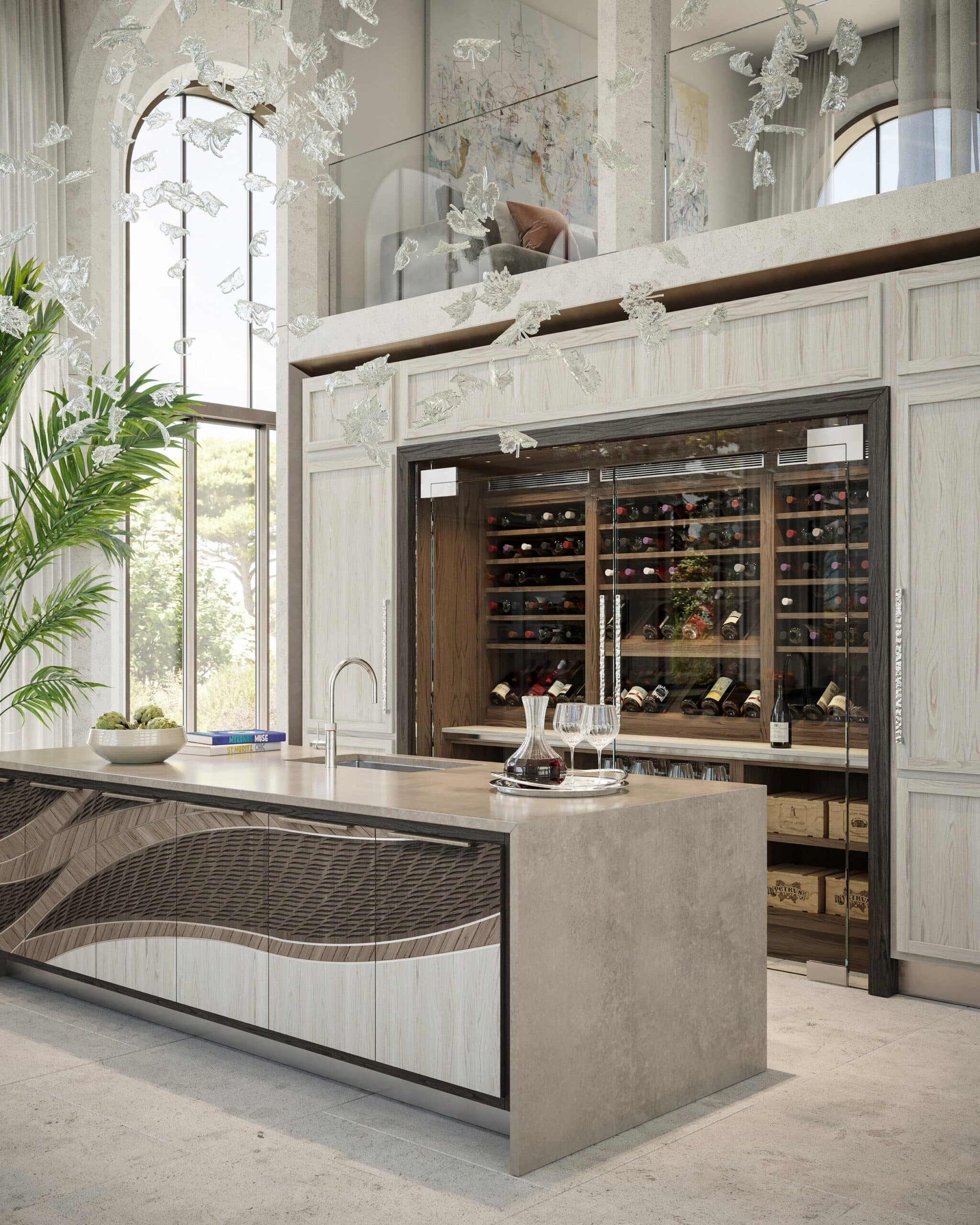
Wine storage integrated into Clive Christian’s Opus kitchen.
Wine collecting has never been more culturally prominent. Where it was once the preserve of a dedicated few, fine wine has become a touchstone of considered living, and wine collecting is finding a new generation of devotees. As collections grow, so too does the question of where and how to house them.
The answer, increasingly, is not a damp corner of the basement. The finest wine deserves a space designed with the same intention as the rest of the home: considered, beautiful, and made to endure. Whether you are planning a dedicated wine room, a floor-to-ceiling wine wall, or climate-controlled storage integrated into a bespoke kitchen, the principles of good wine cellar design are the same, and the results can be extraordinary.
Specializing in luxury bespoke interiors, Clive Christian works with clients and partners to create wine storage that is as much a statement of taste as the collections it houses. Here, we explore the finest wine cellar design ideas, from climate-controlled storage to statement wine walls and the art of personalisation.
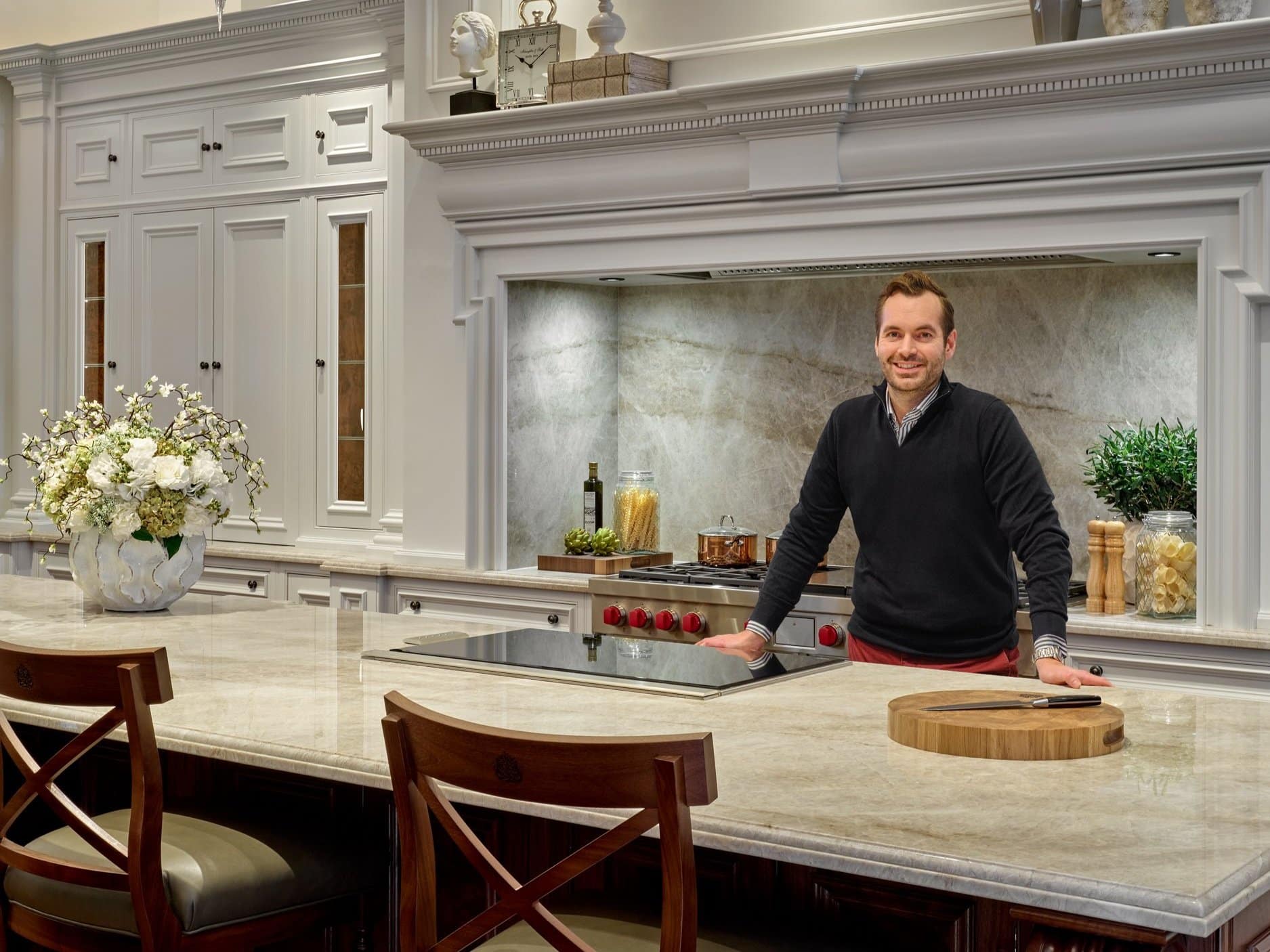
“Where previously these spaces existed in subterranean rooms, our wine displays have evolved into points of decoration, allocated to house clients’ personal favourites, in the same way they may house a fine art collection.”
Oliver Deadman, Head of Design
The science of climate-controlled wine storage
Good wine cellar design begins with the conditions inside it. Wine continues to evolve long after bottling, and the environment in which it is kept will determine whether it reaches its potential.
“Wine likes to be kept in a cool, dark, humid and vibration-free environment,” explains Fiona Love of Spiral Cellars, Clive Christian’s luxury wine storage partner. “An average wine, when left to develop in such conditions, will evolve into something much more complex, characterful and interesting due to a series of chemical reactions that occur over time, altering its appearance, taste and aroma.”
In practice, a home wine cellar or dedicated wine room should maintain a constant temperature of between 8°C and 18°C, with high humidity and low light levels. Temperature-controlled wine storage eliminates the fluctuations that are the enemy of a maturing collection. Central heating, sunlight, and the warmth generated by a busy kitchen can all cause damage over time.
Clive Christian’s bespoke cabinetry is designed with these requirements in mind. Stone worktops, wall mounts, and flooring are selected not only for their aesthetic qualities but for their natural climate-regulating properties. We also work with Spiral Cellars to offer in-floor wine cellars that use cool-to-touch limestone concrete to maintain optimal conditions.
from wine cellar to wine wall: design approaches for every home
One of the most significant shifts in wine cellar design in recent years has been the move above ground. Oliver Deadman, Head of Design at Clive Christian, describes this transformation: “Where previously these spaces existed in subterranean rooms, our wine displays have evolved into points of decoration, allocated to house clients’ personal favourites, in the same way they may house a fine art collection. These spaces are positioned in key entertaining zones, maximising conversation and allowing hosts to guide guests through their exquisite taste.”
Whether you are exploring wine storage ideas for the first time or commissioning a luxury wine cellar for a significant collection, this approach lends itself to a range of wine cellar design ideas, from the intimate to the architectural:
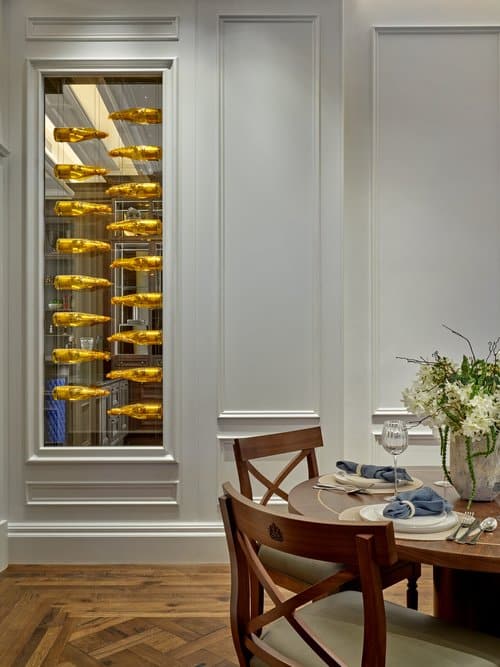
- Wine walls: Floor-to-ceiling displays that transform an entire wall into a curated collection, whether in a kitchen, dining room, or dedicated entertaining space. These can be open or enclosed within glass-fronted cabinetry.
- Integrated kitchen wine storage: Wine displays built into bespoke kitchen cabinetry, often positioned at the heart of the home and designed to be seen as well as used. Clive Christian’s Opus and Architectural collections lend themselves particularly well to this treatment.
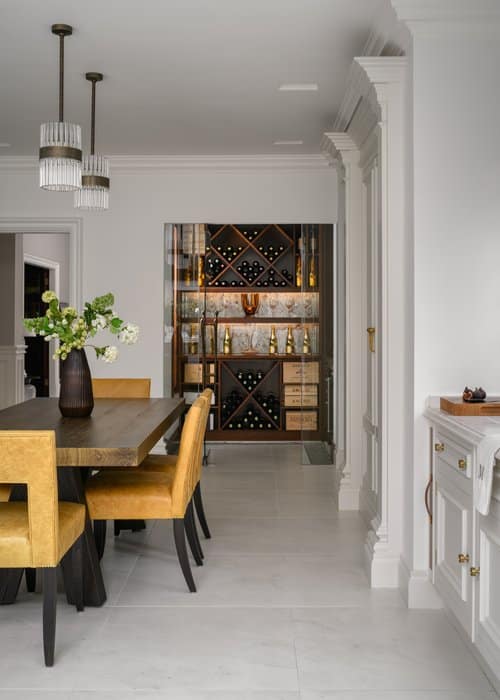
- Dedicated wine rooms: A separate, climate-controlled space, whether a converted cellar, a room beneath the stairs, or a purpose-built addition, designed for serious collectors who require both capacity and precise conditions.
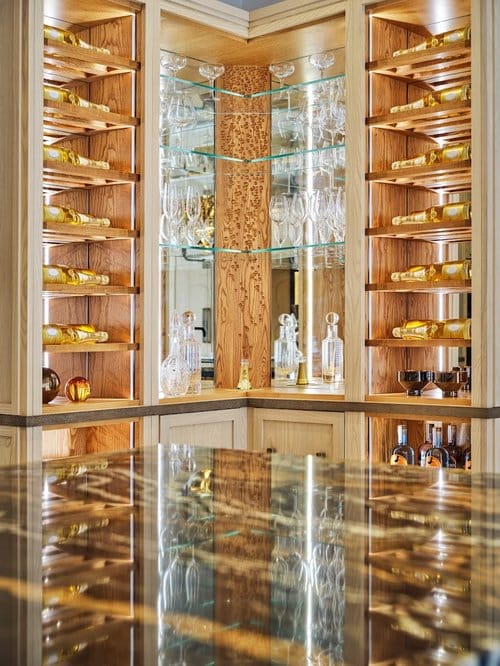
- Drinks rooms and bars: Increasingly, wine storage is designed alongside a broader drinks offering, incorporating spirits, glassware, and a pouring surface within a single beautifully considered space.
The home wine cellar, in whatever form it takes, is no longer a utility. It is a room or a feature that speaks directly to the sensibility of its owner.
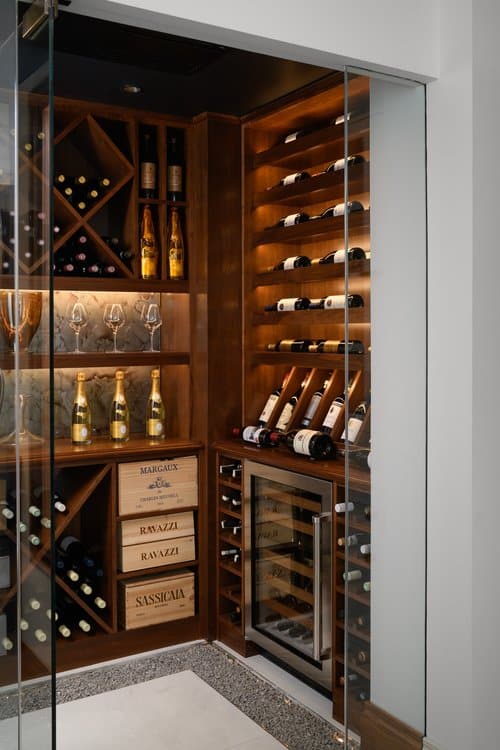
materials, lighting & the art of the detail
The best wine cellar designs balance the functional with the beautiful and the materials chosen for a wine cellar or wine room do much of that work. Clive Christian draws on a carefully curated palette of hardwoods, selected for their structural qualities and their warmth: the grain and depth of a well-chosen timber can make a wine room feel as considered as any other room in the house.
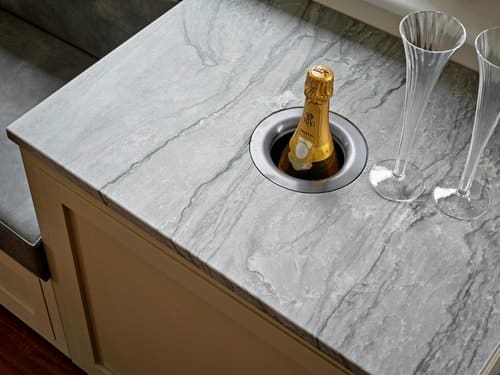
Stone, including limestone, marble, and slate, are incorporated not only for their visual character but for their natural capacity to regulate temperature and humidity. Combined with hardwood racking and joinery, stone creates spaces that age as gracefully as the collections they contain.
Lighting deserves particular attention. Standard domestic lighting can damage wine over time: ultraviolet light degrades organic compounds, and excessive heat from poorly positioned fittings can destabilise temperature. Low-UV LED lighting is the appropriate choice for any serious wine storage design, and when positioned thoughtfully, beneath shelves, behind glass, or focused on individual bottles, it allows a collection to be displayed as it deserves.
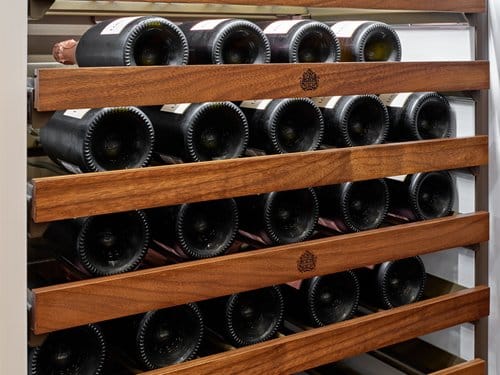
Clive Christian’s bespoke cabinetry also incorporates tilting shelves that allow bottles to be stored either horizontally or at a 45° angle, cork pointing downwards. This is not merely a practical consideration: displaying labels and foils is an aesthetic choice in its own right, treating each bottle as the work of craft it is.
personalising your wine room
A bespoke wine room is, by definition, an individual commission. The best briefs are those that reflect not only how a collection is stored, but how it is enjoyed, and that requires thinking beyond the racking.
One of the most memorable commissions our design team has undertaken illustrates this perfectly, as explained by Oliver Deadman: “An aerating trough was installed within the floor, filled with limestone chippings. The proprietor poured the wine into the dedicated zone so that the aromas filled the air while they enjoyed a glass.” Such details are only possible when a space has been considered in full, not as a storage problem to be solved, but as a room to be lived in.
Fiona Love recommends thinking carefully about how a wine room might evolve as a collection grows: “Do you need space for case storage, or larger, unusual-shaped bottles or even spirits? Will the room require stemware storage space, a pouring table or a sink?” These are the questions that, when answered at the design stage, ensure a wine cellar remains as useful in ten years’ time as on the day it is installed.
Clive Christian’s design team works with clients through every stage of this process, from initial brief to final installation. Each wine room is designed to integrate seamlessly with the wider architecture of the home, not as an addition, but as a natural extension of it.”
building your wine collection
Storage considered, the question turns to what will fill it. Alexandra Tilling of wine importer MMD advises new collectors to begin by deciding whether their collection is primarily for consumption or investment, or, more likely, both: “Historically the idea would be to buy a couple of cases, one to lay down and age with a view to consuming and the other with a view to selling. The one you sell would ideally then cover the cost of the one you keep.”
Tilling recommends buying wine en primeur, before it has been bottled, when it is typically at its most affordable, and taking advice from a wine merchant who can help navigate these decisions and ensure access to the most sought-after allocations.
When it comes to curating the collection itself, variety is key: “I would recommend a selection of wines to invest and to consume, and a blend of earlier maturing wines, or ones you enjoy drinking.” Mixing regions also allows you to stagger the drinking windows: “It is definitely worth exploring the up-and-coming regions that are producing some really exciting wines, such as South Africa, Bierzo and Ribera Sacra in Spain, Greece, premium Chile – alongside the wines that require a bit more age (the more tannic wines).”
For those uncertain whether a bottle is ready to open, a Coravin (a device that allows wine to be sampled without removing the cork) removes all doubt without sacrificing the contents. A well-designed wine storage solution makes it easy to monitor a collection and enjoy it at precisely the right moment.
begin with a conversation
Whatever wine cellar design ideas you are exploring, the process at Clive Christian begins in the same way: a careful, collaborative conversation about how a space will be used, what it should express, and how it will be made.
Whether you are considering climate-controlled wine storage integrated into a bespoke kitchen, a dedicated wine room for a serious collection, or a wine wall that becomes the centrepiece of an entertaining space, our design team is on hand to guide the process from the first sketch to the finished room.
To begin designing your bespoke wine room or wine cellar, visit a Clive Christian showroom or speak with our design team.
Frequently Asked Questions about Wine Storage
What temperature should a wine cellar be?
A wine cellar should be maintained at a constant temperature of between 8°C and 18°C (46°F–65°F), with high humidity and low light levels. Consistent temperature is more important than the precise degree; fluctuations cause more damage to wine than a temperature that sits at the higher or lower end of the ideal range.
What is a wine wall?
A wine wall is a floor-to-ceiling display of wine bottles integrated into the design of a room, typically a kitchen, dining room, or entertaining space. Rather than being hidden in a cellar, the collection becomes a design feature in its own right, displayed within bespoke cabinetry and lit to showcase individual bottles.
How should wine be stored at home?
Wine should be stored horizontally or at a 45° angle with the cork pointing downwards, in a cool, dark, humid, and vibration-free environment. Climate-controlled wine storage, whether a dedicated wine room, in-floor cellar, or integrated cabinetry, is the most reliable way to maintain optimal conditions at home.
What materials are best for a wine cellar?
Natural materials, including hardwood, limestone, slate, and marble, are ideal for wine cellar design because of their natural capacity to regulate temperature and humidity. Hardwood racking provides structure and warmth, while stone elements contribute to a stable climate. Low-UV LED lighting is recommended to protect wine from light damage.
Does a wine cellar add value to a home?
A well-designed wine cellar or wine room can add significant value to a property, particularly at the luxury end of the market. Bespoke, climate-controlled wine storage is increasingly sought after by discerning buyers who see it as an indicator of quality and care in the home’s design as a whole.